Code Faster in Delphi
“This book will make you a faster Delphi developer, it doesn’t matter if you are just starting out, or have been using Delphi since version 1, you will find all sorts of tips, tricks and hacks to boost your productivity.” https://leanpub.com/codefasterindelphi
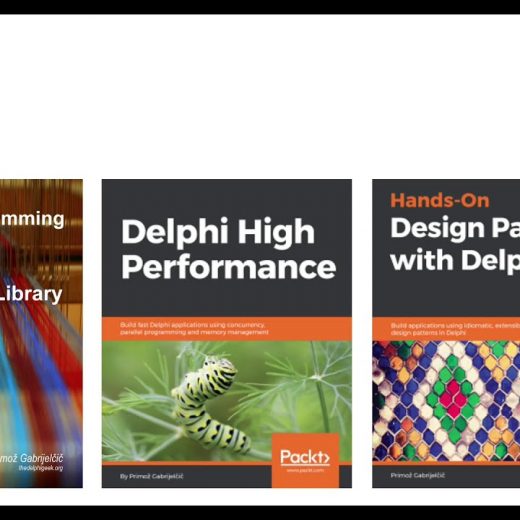
TMS WEB Core: Web Application Development with Delphi
(Available on Amazon .COM .CA .DE .CO.UK .FR .IT .ES .CO.JP) Discover the endless possibilities of software development with TMS WEB Core … For more than two decades, the development environment Delphi is known for the rapid programming of Windows applications. Especially the easy creation of desktop database applications and the uncomplicated deployment of the applications to customer systems made Delphi popular compared to other programming languages. For several years now, software can be created for the target platforms Linux, MacOS as well as the mobile operating systems iOS and Android. With TMS WEB Core, modern web applications can be programmed with Delphi since the beginning of 2018. These applications can be executed completely in the web browser because they are translated into JavaScript. Detailed description of the basics, the functionality, and the transpiler (based on pas2js) Step-by-step creation of the first web application Progressive Web Applications (PWA) for offline use Electron applications: Cross-platform Desktop applications based on web applications Integration of JavaScript classes and controls Creating web services for databases with TMS XData Integration of databases with TDataset controls XData-specific functionality for use in web applications Responsive web design (form designer, HTML, CSS, Bootstrap) The final chapter provides a comprehensive and practical example of server and web application with Google Maps and Google Charts The content is suitable for both beginners and advanced developers interested in creating web applications with TMS WEB Core. Knowledge of Delphi (Object Pascal) and the Visual Component Library (VCL) is required. To reproduce the numerous examples, you need a current version of Delphi and TMS WEB Core. The free Delphi Community Edition is sufficient as well as the trial version of TMS WEB Core.
Hands-on with Delphi: Cross-platform Multi-tiered Database Applications: Web and Desktop Clients, REST/JSON Server, and Reporting
Learning Delphi by example! (Available on Amazon .COM .CA .DE .CO.UK .FR .IT .ES .CO.JP) Delphi has been established as one of the best software development tools for Windows desktop applications. Since its inception in 1995, it has constantly grown with the challenges of the IT industry. Today, applications often must be deployable to multiple platforms or mobile devices and offer non-proprietary interfaces for interaction with other software or hardware. TMS Software has been offering software components and products specifically designed for Delphi developers since the first version of Delphi. From recent seminars, conferences, and events TMS realized that practical examples how to make use of their components and products have the greatest learning effect. This idea lead to the Hands-on series.In this first book of the Hands-on series, several examples for a reproducible usage scenario are built. Write a professional web service for a database with over 8 million records. Design VCL, FireMonkey and TMS WEB Core web clients for multiple platforms and devices. Implement a reporting service with XData. Generate signed PDF documents with a customizable template. Add a token-based login to your services. Build user interfaces with vector images to be ready for any display resolution. Encrypt sensitive data using modern algorithms. Use parallel programming to build responsive client applications. Write better code with static code analysis.
Hands-on with Delphi: FNC Maps: Cross-framework, Cross-platform, Cross-service Mapping Component Library
(Available on Amazon .COM .CA .DE .CO.UK .FR .IT .ES .CO.JP) Learn to build modern Delphi applications for multiple platforms with maps and geographic focus by example! Delphi comes with native compilers for Windows, Linux, Apple macOS, iOS, and Android. TMS Software has been offering software components and products specifically designed for Delphi developers since the first version of Delphi. From recent seminars, conferences, and events, TMS realized that practical examples how to make use of their components and products have the greatest learning effect. This idea led to the Hands-on series. In this second book, applications that make use of FNC Maps are front and center. It is a new component-based framework to access mapping and other geographic services from Google Maps, TomTom, Microsoft Bing Maps, Microsoft Azure, Mapbox, Here, and OpenLayers. Be it in the VCL, FireMonkey, or LCL, using the framework is as easy as dropping a component on your form. It delivers Rapid Application Development at its best. All topics are explained with examples that can be transferred to your specific use case easily. Get to know the FNC framework, FNC Core, and FNC Maps in a nutshell. Learn about FNC Maps in detail: You will find dozens of hands-on examples from installation to modern multi-tier applications with large databases, web services, web, and desktop clients. Annotate maps and visualize data using markers with clustering, lines, shapes, pop-up windows and routes. Build applications that can handle any geographical data and interact with other Geographic Information Services (GIS). Load GPX tracks from GPS devices, GeoJSON shapes, and Google Earth-specific KML layers. Include other mapping services to get directions with turn-by-turn instructions, to geocode addresses, and to determine your geolocation. Create reports with a customizable template based on data from maps and databases. Allow users to freely customize maps using events or interactive markers and shapes. Examples use TMS FlexCel, FNC Core, VCL UI Pack, WEB Core, Cryptography Pack, and XData. Embarcadero Delphi Sydney 10.4 or newer suggested. Trial versions and free developer accounts of service providers suffice to run the examples. SQLite database examples are ready for use without server setup. Basics for reporting, web, and XData explained in “TMS WEB Core: Web Application Development with Delphi” and previous Hands-On titles are not included again but referenced.
Discover Data Types in Delphi In This Learn Delphi Video Series
In this video, which is part of the Delphi Series for Beginners, we will learn more about the different types of data that can be stored with a Delphi Program. Learn what exactly is a Data Type and how do we choose the correct Data type? The video will give us comprehensive details and comparison among different data types that can be stored with a Delphi Program from Numeric Data Types to Character Data Types, and more. According to the video, these data types are not the only ones available in Delphi but they are the ones being used more often. Knowing that these data types are also generally used by other programming languages, it is very important to know every detail about them. Above all, these data types can also be used to store values in short term memory as variables or in databases as fields. Watch the video above to learn more data types, their variations, and their function.
Discover Data Storage in Delphi With This Learn Delphi Video
The video above will help us learn everything we need to know about Data Storage and the Data structure in Delphi Code. This will also highlight and explore the differences in short term storage in memory and long term storage on hard drives. The video will also share details on where and how to store data and resources permanently so we can save them and use them in the future. According to the video, almost all the important information used in the Delphi Program is taken from data stored in various files such as Text files and XML Files. Data can also be stored using Spreadsheets or Documents using software like Microsoft Excel and Microsoft Word respectively. Feel free to watch the video above and learn how to store data on a text file as well as saving data permanently by storing it on a database.
Discover Annotating and Commenting Your Delphi Code With This Learn Delphi Video
In this video, we will learn how to annotate and comment on your Delphi code to make it more readable for your teammates, colleagues, your teachers, and also for yourself. You will learn the importance of commenting and annotating the Delphi code and what are the benefits you can gain from it in return. According to the video, by commenting and annotating your code, you generally describe what your code means and it makes it easier for everyone to read them. In addition to that, annotating and commenting on your code allows you to create documentation for your program which makes it easier for you to locate problematic codes or areas that need change or revision in the future. This method also helps you analyze or assess the purpose of your code as quickly as possible. Feel free to watch the video and see the step by step procedure on how to annotate or comment on your code.
Explore the Concept of IPO (Input, Process, Output) in Programming With This Learn Delphi Video
After learning about how to declare variables in a Delphi Project, it is time to explore another important aspect of Delphi Programming. In this Learn Delphi Video tutorial, we will learn about the concepts of IPO or the Input, Process, Output. It is important to note that in order to make programming easy and to plan a consistent flow for Delphi projects, most software developers often apply the concepts of IPO. Discover more about this important methodology in programming and learn how to apply such concept in a Delphi Project and how it can help you easily structure and plan your code in a logical manner. This Learn Delphi Video Tutorial will demonstrate the layout of an IPO table and how to apply it on a project, by declaring variables and populating them.
Learn How to Declare Variable in A Delphi Project in This Learn Delphi Video
In this Delphi Programming tutorial video, we are going to learn more about the variables and what exactly is their role in Delphi programming. According to the video, variables are containers or placeholders in memory with specific data types such as byte, integer, string, and more. We also learn that those variables are declared using a descriptive name that follows naming rules and conventions. You will also learn about the characteristics and purpose of a variable in this Learn Delphi Video tutorial. Interestingly, this video will teach you how to properly declare and use variables in a Delphi Project. To explore more about variables in Delphi Programming, feel free to watch the video above.